Scaling the sovereign agentic enterprise: what leaders need from AI in production
Deliverance AI co-founder Mick McNeil convened senior leaders from enterprise technology, telecoms, biotech and finance in central London to examine what it takes to move agentic AI beyond pilots into production — where responsibility, cost-effectiveness and a governed operating layer decide who pulls ahead.
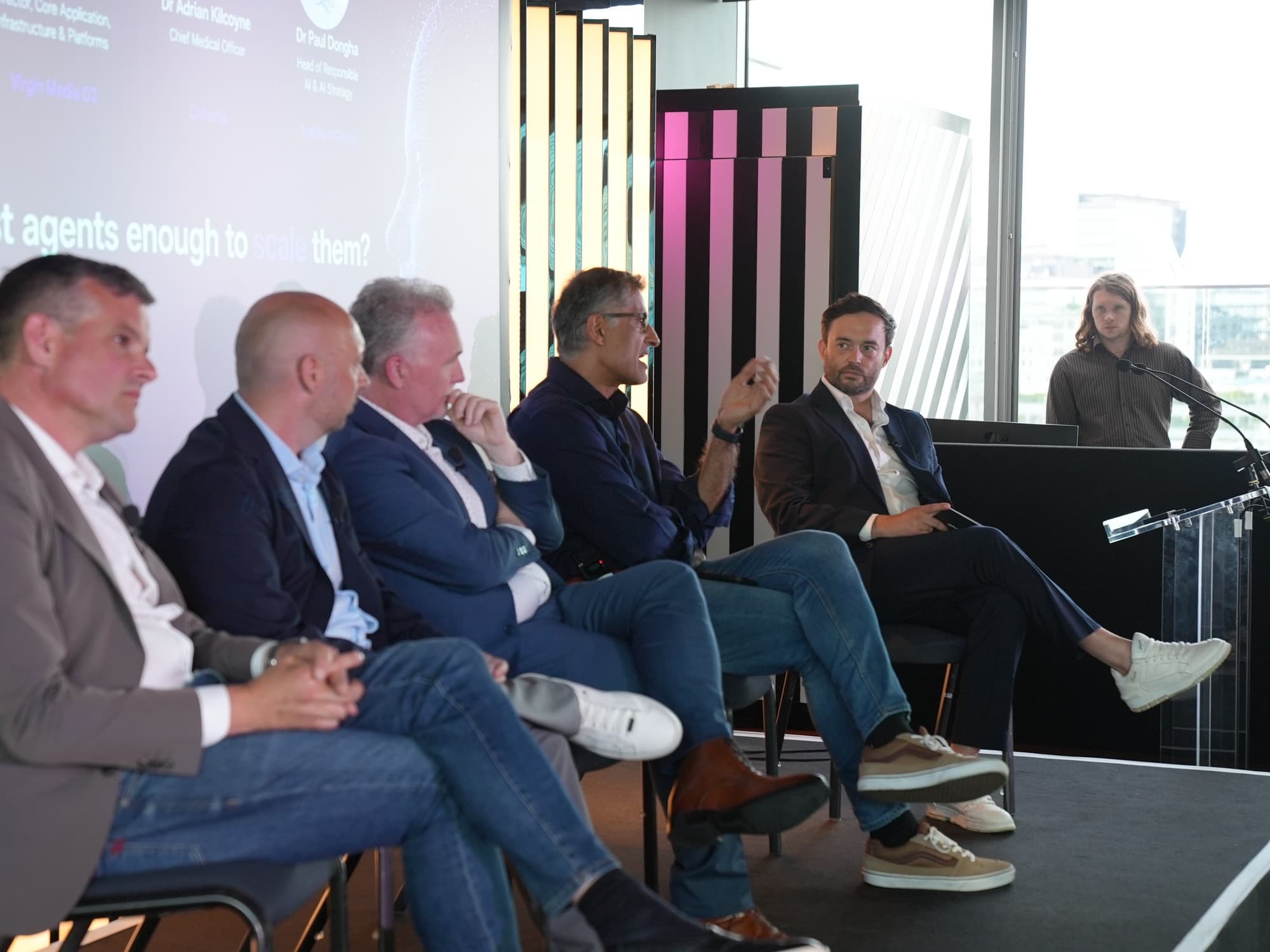
Deliverance AI recently hosted a focused discussion in central London on the matter of how to scale agentic AI most effectively. It's a pertinent question facing enterprise leaders, and one that's increasingly becoming the difference between stealing a march and lagging behind in the race to unlock more operational efficiencies and higher profit margins.
The session, led by Deliverance AI co-founder Mick McNeil, brought together senior leaders from across enterprise technology, telecoms, biotech and finance to examine what it takes to move AI beyond models, pilots and isolated experiments, and into production environments where it can create measurable value.
Time and again during the evening's discourse, responsibility and cost-effectiveness were the critical ingredients pinpointed for enterprises to succeed in that increasingly influential endeavour.
This is also what we at Deliverance AI are witnessing to a greater and greater extent; enterprises seeking to rapidly extend beyond models and pilots, and into the infrastructure required to make agentic AI work in production.
The basics for doing this are in play; they have access to models, cloud platforms, infrastructure and internal demand. But what many in regulated industries still need is the operating layer that allows agentic AI to work safely inside real business environments. Implementing that effectively necessitates defined boundaries, engineered guardrails, accountable agents, clear ownership and measurable outcomes.
It also means treating agents less like a feature and more like a workforce. Enterprises are beginning to deploy agents across repeatable, high-volume workflows, and those agents will therefore naturally need training, context, supervision and trust. They will need to understand the environment they are operating in, the policies they are bound by, the tools they can call, and the point at which a human needs to intervene.
That is why governance cannot sit around AI as a later-stage compliance exercise; entirely to the contrary, it has to be embedded into the architecture from the outset.
For regulated organisations in particular, this is becoming increasingly business-critical. Agentic AI introduces new questions around autonomy, accountability, cost and control. Once agents begin making decisions, calling tools and acting across business workflows, organisations need to know what is happening, why it is happening, who owns the outcome and how the system can be paused, audited or corrected. That groundwork – that infrastructure – is what enables governance to become operationally efficient.
The same is true of ROI as organisations go along the journey from experimentation into production, and the pressure to prove value will only see a commensurate increase. But contrary to popular opinion, ROI here needs to be considered in the wide across the enterprise. It should also extend beyond costs saved, and simultaneously account for better decisions, more consistent outputs, stronger employee experience, faster customer response and improved operational resilience. All of that taken together creates the value delivered by effectively managed and accountable enterprise AI solutions.
The most immediate value often comes from the work enterprises already understand; that is, those repeatable, high-volume workflows where agentic AI can remove friction, reduce manual effort and free people to focus on higher-value tasks.
That is where secure, governed production comes into its own. Those who come out on top in the next phase of enterprise AI will be those who can deploy AI into live workflows with the right controls, the right economics and the right level of trust.
Enterprises need the ability to run agents, govern runtime behaviour, route work across models, control cost and maintain visibility over data, decisions and outcomes inside their own environments. Which, taken collectively, makes the operating layer the key ingredient to get right when setting up a production strategy for success. Which is also exactly what the era of experimentation has led us to pursue in earnest.
Thank you again to the participants in our fascinating discussion – James Brooks, Chris Buggie, Dr Adrian Kilcoyne, Dr Paul Dongha – for their contributions, challenge and practical advice to the industry on implementing agentic AI in a way that is responsible and cost-efficient.
Want to see this running against one of your workflows?
30-minute demo · your use case · response within one business day.